UI/UX
Nutrio is an AI-powered food product development platform designed for entrepreneurs, startups, and R&D professionals to ideate, formulate, and source ingredients seamlessly
Details
Project
Salesforce, Relationship Design Challenge ‘25 Submission (Finalist)
Role
Solo Product Designer
Duration
5 Days
How might we create an AI-powered virtual product development studio that enables brands to go from idea to validated formulation, without ever entering a physical lab?
Target Users
Nutrio is built for professionals involved in food product creation and innovation
• Solo Entrepreneurs – Individuals developing and testing new food ideas independently
• Startup Founders – Brand owners creating and scaling innovative food products
• Corporate R&D Professionals – Experts optimizing formulations and ensuring product compliance
Research
The goal of my research was to understand how food product development works, the challenges faced by food startups and R&D teams in bringing new products from idea to formulation, identify inefficiencies in the current process, and explore how AI could simplify and enhance different stages of product development
Market Research Insights
Key industry statistics highlighting the growing need for faster, data-driven, and cost-efficient food formulation and development solutions
Key Stages in Food Product Development
As my challenge focused on the Ideation and Formulation phase only, I conducted in-depth research to understand how these stages operate and where inefficiencies or gaps exist
Product Development Types
In the food industry, product development can be broadly classified into two key categories
1.New Product Development-
Involves creating a completely new product from concept to market launch — starting with idea generation, ingredient sourcing, lab formulation, testing, and scaling up for production and commercialisation
2. Line Extension-
Involves creating a completely new product from concept to market launch — starting with idea generation, ingredient sourcing, lab formulation, testing, and scaling up for production and commercialisation
Virtual Lab Exploration
To understand how digital environments replicate real lab experiences, I explored platforms like ChemCollective and BASF Virtual Kids’ Lab
These tools helped me learn how virtual labs visualize experiments, provide real-time feedback, and guide users through complex procedures interactively
Projected growth of the Market for Food Processing Technology in India by 2024, showing strong industry investment in technological solutions
Source - IBEF
₹2.5L Crore
The projected growth rate of the Organic Food Market in India by 2025, driven by evolving consumer demand for specialised, healthy products, requiring faster and more precise R&D
Source - Indian Organic Market Report (2022)
20% CAGR
The cost range for the Recipe Formulation phase alone for a general food product, which typically requires multiple physical trials
Source - Foodsure (2025)
₹1.5 - 3.5L
1
Ideation
Generating product ideas based on market needs and trends
3
Processing
Scaling the lab formulation for consistent large-scale production
4
Commercialisation
Finalizing packaging, compliance, sourcing, and market launch
3
4
2
1
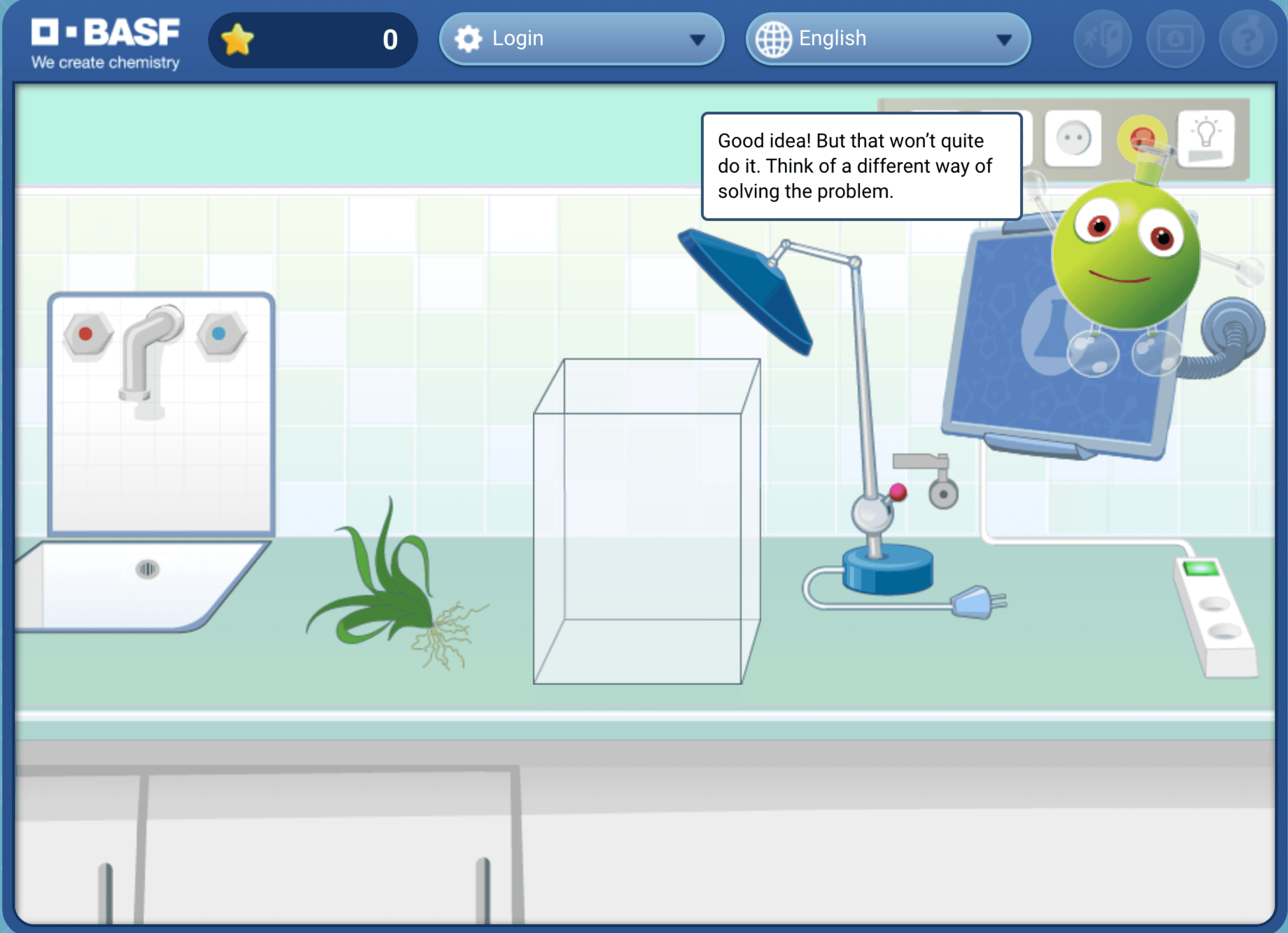
Workspace area
Interactive centre aligned workspace area
Avatar
Avatar pops up to guide for next steps, but users can not interact with it
BASF Virtual Lab
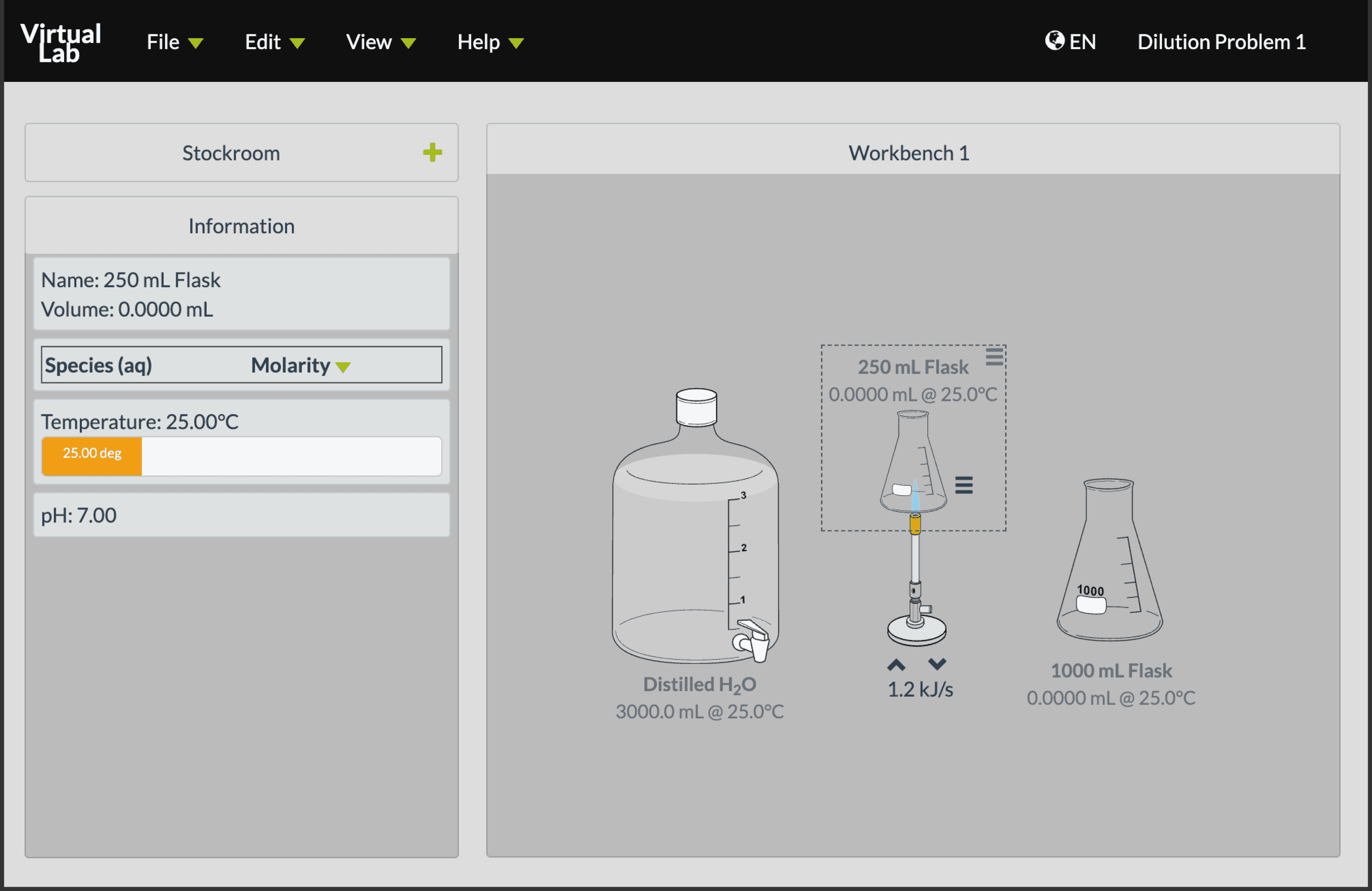
Lab Equipments
Left aligned, collapsible workspace area, the items are fixed based on ongoing experiment
Workspace Area
User can drag equipments from left panel and can perform experiment in this area
Chemcollective
Virtual Lab
Current user flow
Understanding how food innovators currently move from idea to formulation, highlighting the inefficiencies and loops in the existing process
Idea Generation
Concept Definition
Ingredient Research /
Feasibility Check
Formulation Drafting
Lab Testing /
Prototype Trial
Preliminary Evaluation
Identifying Pain Points Across the User Journey
Understanding how food innovators currently move from idea to formulation, highlighting the inefficiencies and loops in the existing process
Ingredient Research / Feasibility Check
• No centralised database to compare ingredient availability, cost, or compliance
• Manual research consumes days, often resulting in incomplete or outdated data
Formulation Drafting
• Requires physical lab access and expert knowledge for accurate ratios.
• Difficult to understand how changing one ingredient affects nutrition, stability, or cost
• Limited visibility into alternative ingredients with similar functions
Lab Testing / Prototype Simulation
• Highly time-consuming and expensive (each trial costing ₹15,000–₹30,000)
• Multiple iterations needed before achieving desired taste or texture
• Lacks predictive tools to estimate shelf life or sensory profile digitally
Preliminary Evaluation (Cost, Nutrition, Compliance)
• Evaluations are done manually or using separate tools, breaking workflow continuity
• No real-time feedback; users only know results after full testing
• Compliance checks require regulatory expertise not accessible to startups
User Personas
I identified two key user types representing different goals — one focused on creating new products and another extending existing ones within established brands

Problems
• Limited access to R&D labs and formulation experts due to high cost
• Iteration cycles are slow — physical trials take weeks to test taste and stability
• Limited access to R&D labs and formulation experts due to high cost
• Limited access to R&D labs and formulation experts due to high cost
Goals
• Rapidly prototype and validate new product ideas digitally
• Compare formulation variations in real-time before physical testing
• Ensure compliance and nutrition balance early in the process

Pravin Sharma
29, Founder, YogCraft – a health food startup

Problems
• Reformulating the existing recipe to include probiotics changes the drink’s shelf stability and flavor balance
• Limited lab time and high trial costs make iterative testing difficult
• Difficulty in finding compliant probiotic ingredients that match brand flavor standards
Goals
• Digitally simulate how probiotic addition impacts taste, nutrition, and shelf life
• Maintain Paper Boat’s signature fruity taste while improving health perception

Nisha Kapoor
30, Senior R&D Technologist, Paper Boat
NUTRIO
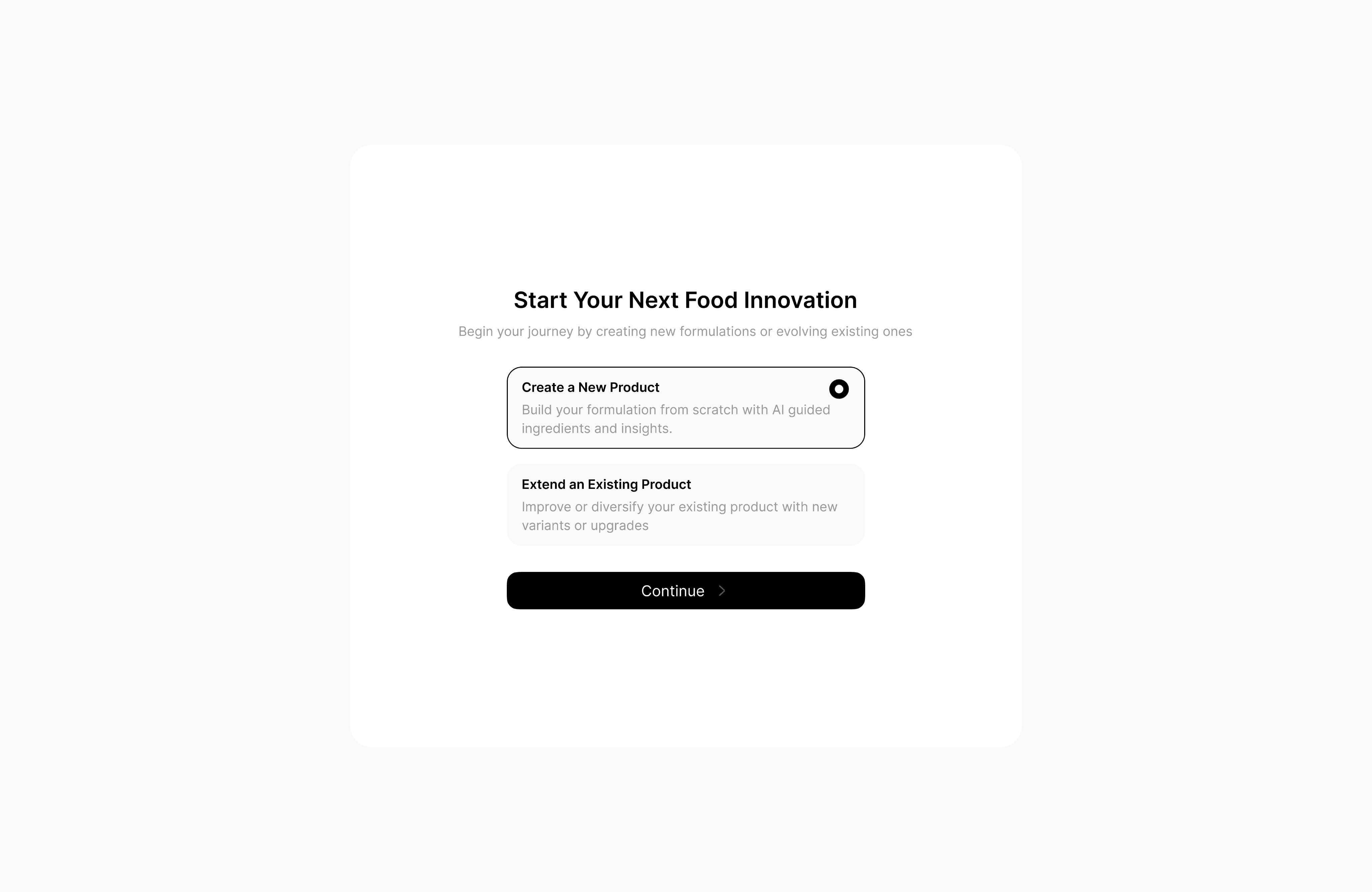
Choose product type
User will be given options, is it new product or line extension of existing product
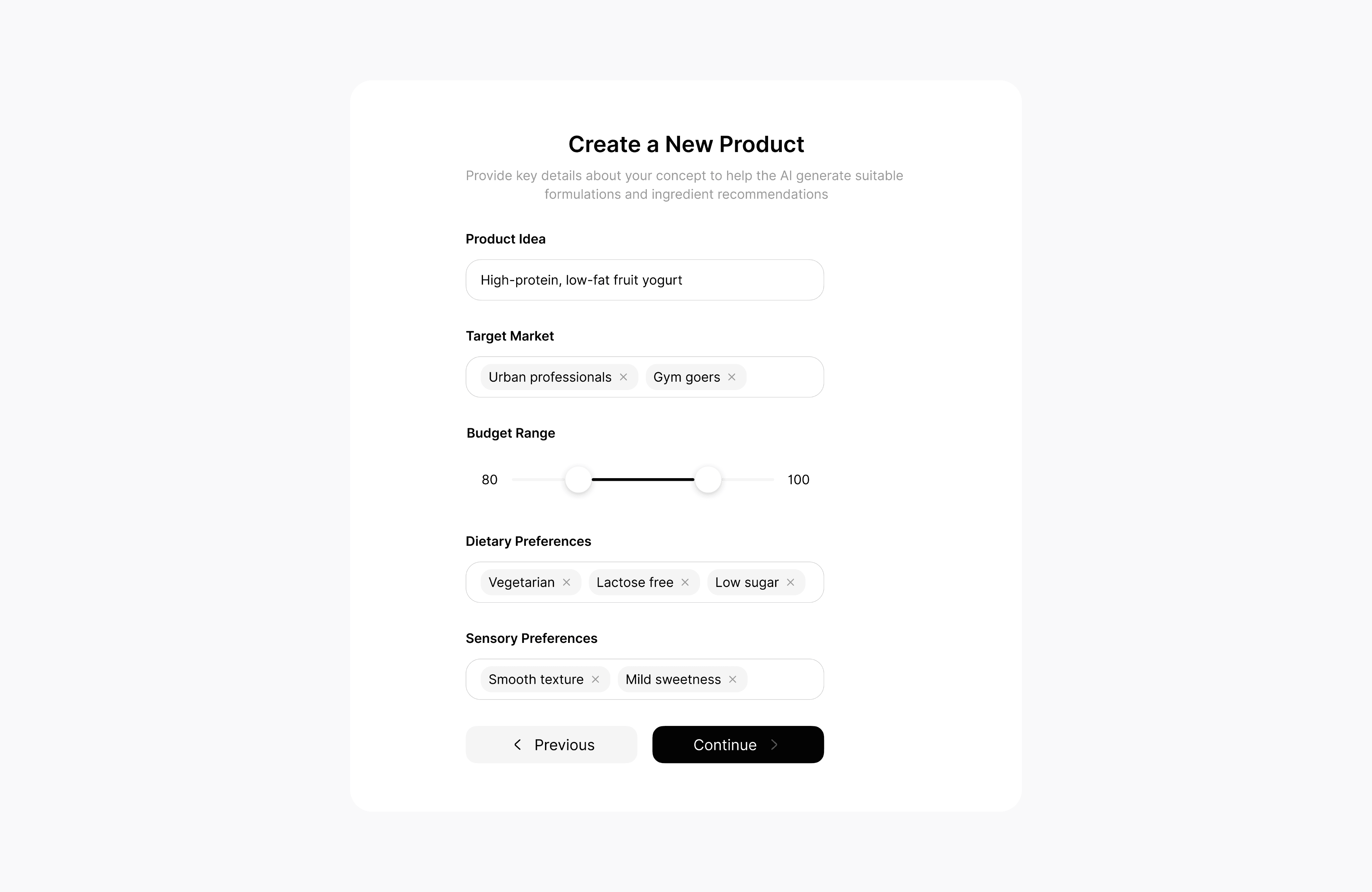
Creating a new product
The details collected at this stage are later used by the AI to generate insightful and feasible formulation suggestions.
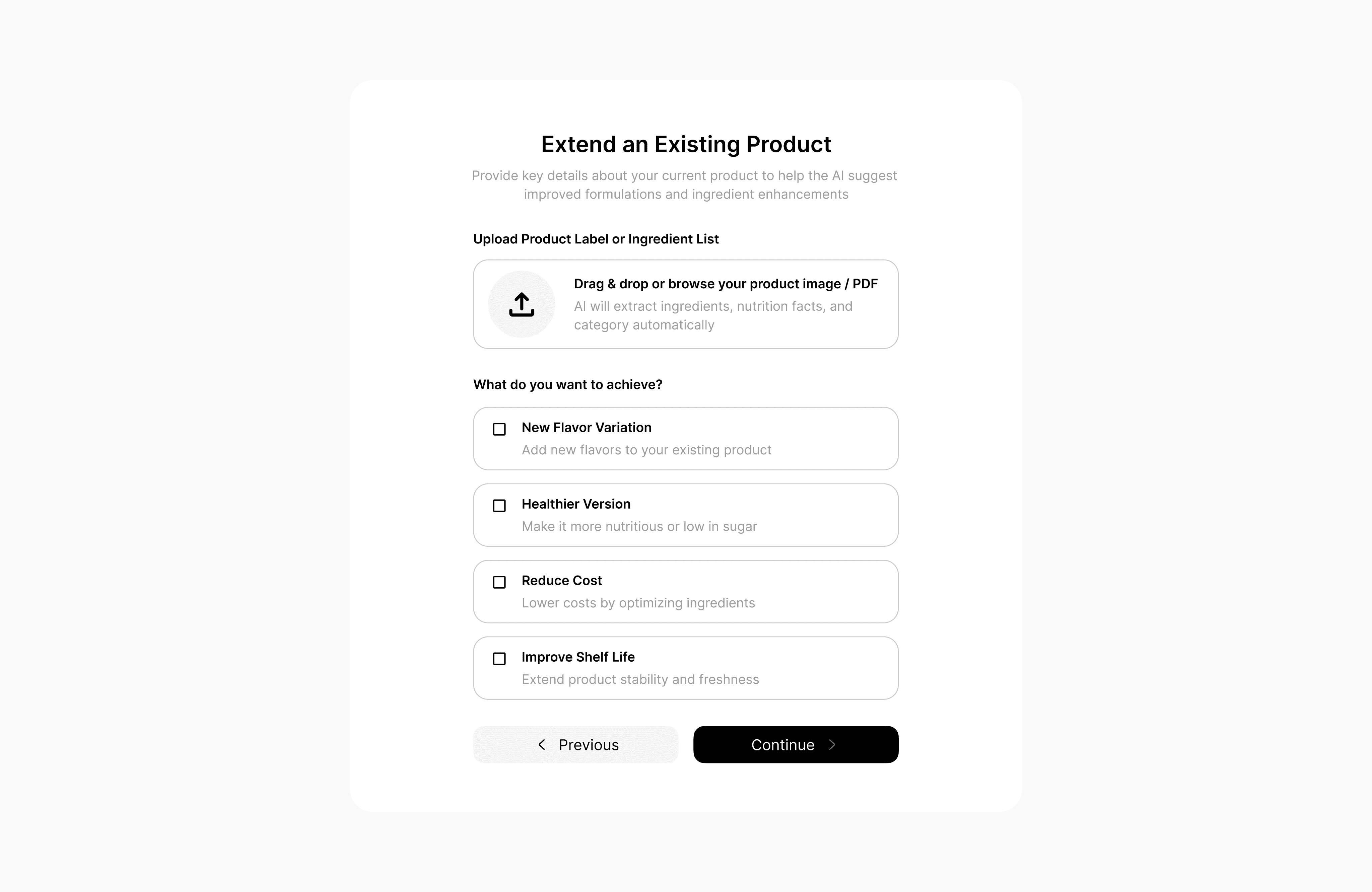
Line extention of product
Creating a new product
Ai will automatically extract ingredients, nutrition facts and category automatically
New user flow
This flow illustrates how Nutrio supports and enhances existing food R&D workflows by assisting users from feasibility to sourcing, helping them make faster, smarter, and more confident formulation decisions
Proposed Solution
A virtual platform that simplifies food product development by assisting users in formulation, evaluation, and ingredient sourcing through AI support
Idea Generation
Concept Definition
AI-Generated Ingredient Listing
Virtual Lab Simulation
AI Evaluation
Ingredient Sourcing
Ideation Phase
As stated in the problem statement, users enter the platform with a clearly defined product concept. Therefore, at this stage, I did not focus on providing insights or feedback on the idea itself, assuming it has already been thoughtfully developed by the user.
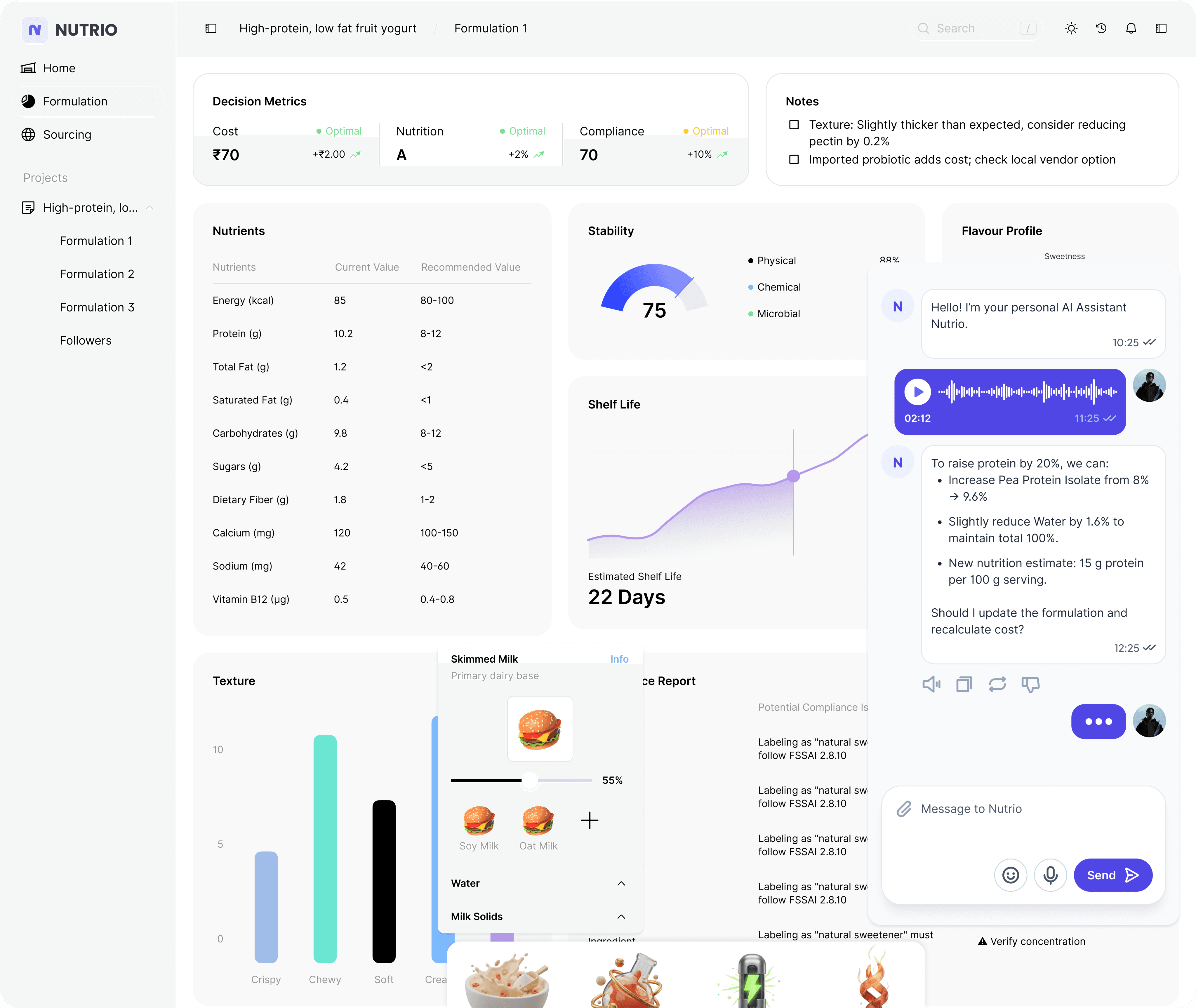
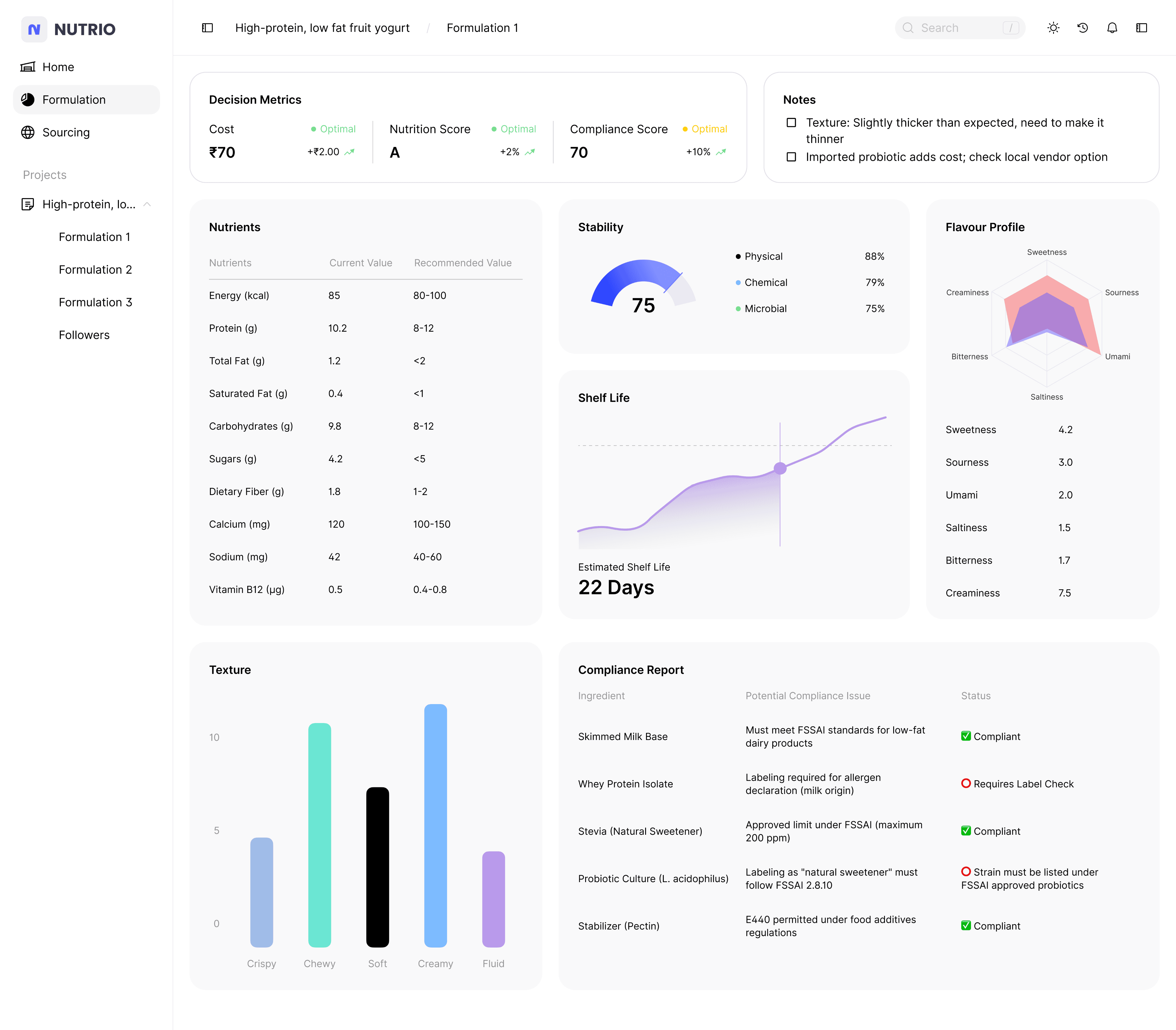
Decision Metrics & Notes
Ai will automatically extract ingredients, nutrition facts and category automatically
Product Performance Insights
Comprehensive AI-driven analysis showing how each formulation performs across nutrition, stability, and sensory attributes
Formulation Workspace
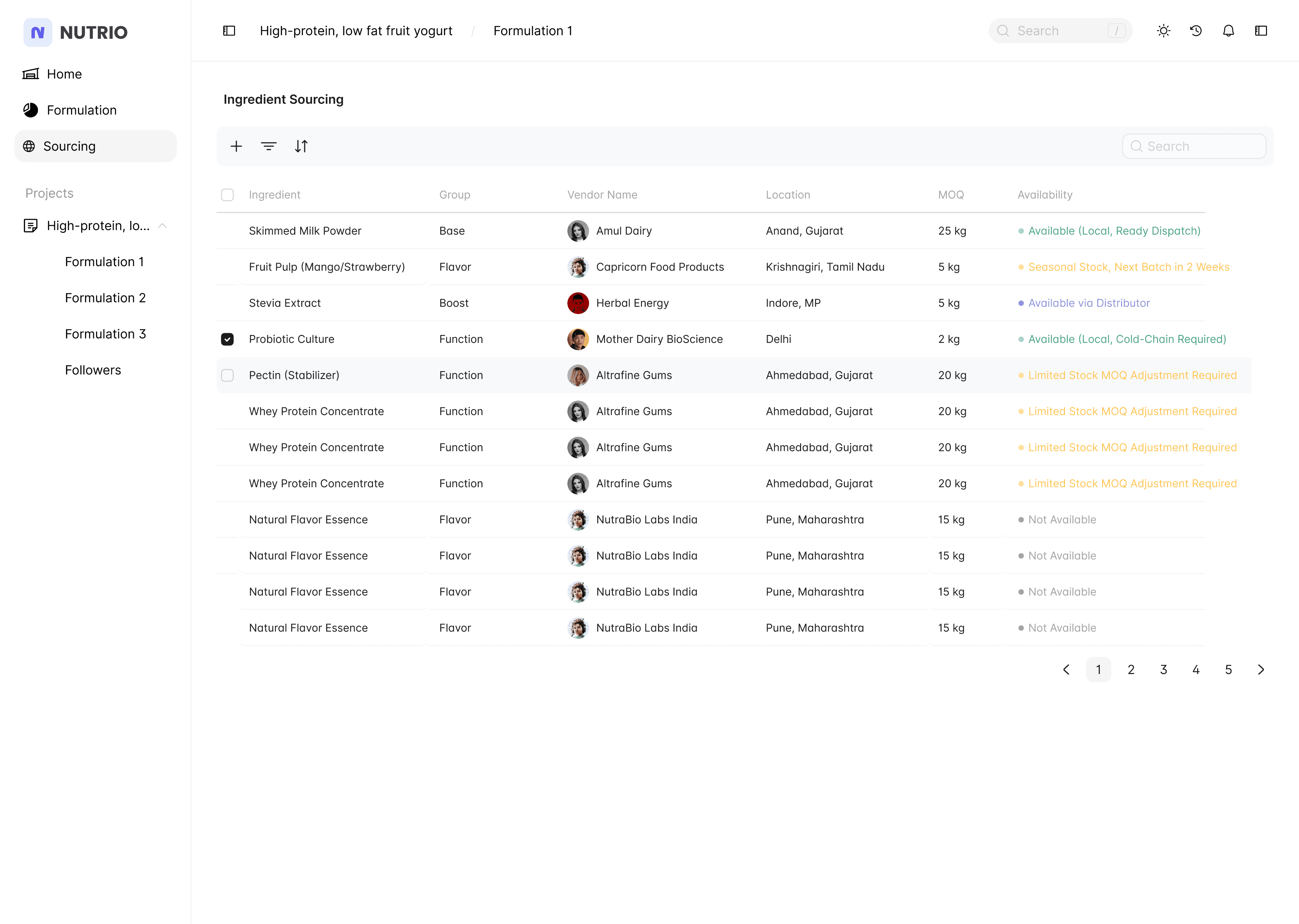
Ingredient Sourcing
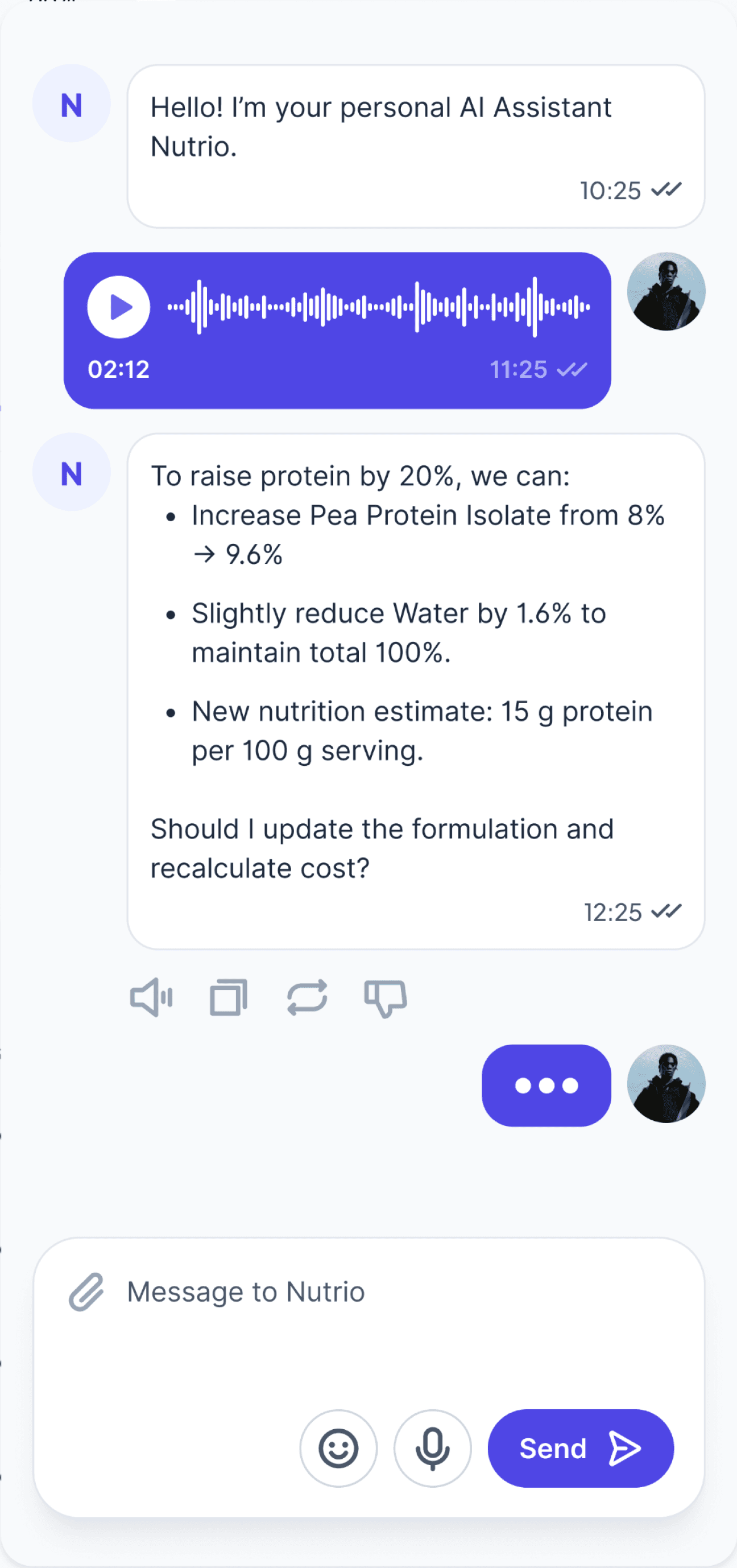
AI Chatbot
User will ask best next step to take in formulation, ask queries in text and audio format
Ingredients
Ingredients are auto-suggested based on the product concept, allowing users to make “what-if” adjustments and instantly see the impact on their formulation.

55%

Soy Milk
Oat Milk
Water
Milk Solids
Skimmed Milk
Info
Primary dairy base


Formulation Workspace
The core area of the platform where users experiment with ingredients, tweak formulations, and instantly see the impact on taste, nutrition, cost, and compliance — all through an interactive, AI-assisted dashboard
Ingredient Sourcing Page
A consolidated view where users can explore verified local vendors, compare ingredient availability and cost, and finalize sourcing decisions directly from the platform
Project Learnings
Got a deeper understanding of how food product development actually works — from ideation to formulation
Learned how formulations are created, tested, and refined based on taste, nutrition, and stability
Understood how AI can simplify complex formulation decisions and make R&D more accessible